
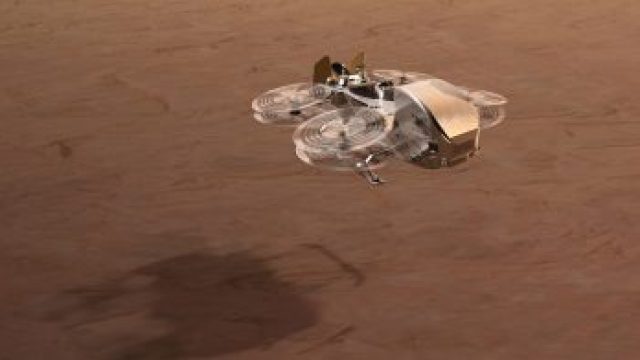
NASA has officially designated the landing area for its innovative Dragonfly mission to Titan, Saturn's intriguing moon. Scheduled to launch in the summer of 2028, Dragonfly aims to arrive at Titan by late 2034. This ambitious mission will focus on the newly named region, Ahmakiq Undae, which is characterized by a mix of sand dunes and inter-dune areas. The selection of this landing site is pivotal, as it opens up new avenues for understanding Titan's geography and potential habitability.
Ahmakiq Undae is located south of the Selk Crater, an area that extends to the edge of a mountainous range. This unique geological feature presents a blend of diverse terrains that scientists believe may provide rich scientific insights. The region’s varied composition and structure are expected to help researchers understand the moon's atmospheric and chemical processes, which may parallel some aspects of Earth's environment.
The geological features found within Ahmakiq Undae are particularly meaningful. With expansive sand dunes formed by wind-driven processes and the presence of possible subsurface liquid oceans, Titan presents a rare opportunity to study extraterrestrial geology. This could potentially compare to Earth-like processes, offering clues about both moons' development.
One of the main objectives of the Dragonfly mission is to analyze materials found in Titan's soil and atmosphere. By conducting airborne reconnaissance, the rotorcraft will investigate various organic compositions, which could answer significant questions about the potential for life beyond Earth.
The interest in Titan and particularly the Ahmakiq Undae region is resonating within the global scientific community. The findings from Dragonfly could reshape our understanding of icy worlds in the outer solar system. In an era marked by advancements in technology and renewed interest in space exploration, this mission signifies a step forward in unraveling the mysteries of our planetary neighbors.
This mission has drawn significant attention not only in the United States but also in the ASEAN region, particularly in Southeast Asia, where countries such as Indonesia are fostering a growing interest in space science and technology. Collaborations between nations could spark new educational initiatives aimed at inspiring the next generation of scientists in the region.
As the countdown to the Dragonfly mission continues, engineers and scientists are refining the rotorcraft's design and mission parameters. Public engagement and educational outreach are also key components of the mission's preparation phase. By conveying the importance of such explorations, NASA aims to inspire curiosity and innovation in fields related to science, technology, engineering, and mathematics (STEM).
With funding secured for the Dragonfly mission, NASA’s agenda continues to push boundaries. Following the Titan exploration, future missions to other celestial bodies, including Europa and Enceladus, are already being considered, emphasizing the importance of continuous exploration in understanding our solar system.
The naming of Ahmakiq Undae as the landing site for NASA's Dragonfly mission is a significant milestone, marking the beginning of an exciting chapter in space exploration. As we await the launch set for 2028, the scientific community is buzzing with anticipation regarding the potential discoveries that await us on Titan.
